
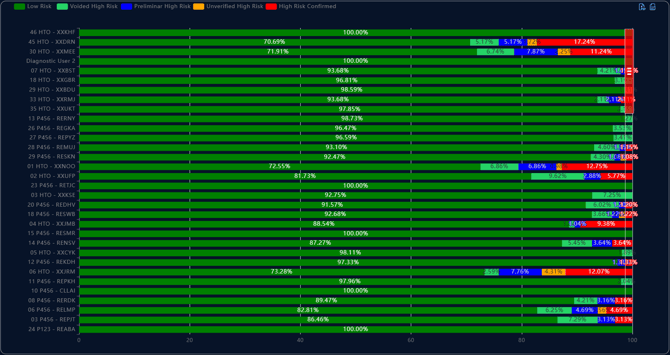
The Percentage of High-Risk vs Low-Risk Results report shows the share of a user’s tests that correspond to risk events relative to their total tests. Unlike absolute counts, this report presents information as percentages, enabling fair, relative comparisons across workers.
How does this report work?
-
Expresses, as a percentage, how many of a user’s tests were low risk and how many corresponded to high risk.
-
Within high-risk results, it differentiates between confirmed, unverified, and predictions.
-
Makes interpretation easier by showing each worker’s relative risk load, independent of their total number of tests.
Available filters
-
Date: select a specific time range.
-
Group: segment information by areas, shifts, or roles.
-
User: view the details of a specific worker.
Usefulness for HSE
-
Identifies users whose proportion of risk results is higher compared to their peers.
-
Complements absolute-count analysis, providing a more balanced view.
-
Helps prioritize preventive actions for workers with a high relative risk share, even if their total number of tests is lower.
Conclusion
The Percentage of High-Risk vs Low-Risk Results report is a key tool to understand the relative weight of risks in operations. By presenting data as proportions, it enables supervisors and administrators to make fairer comparisons and focus management on those with greater relative exposure.