
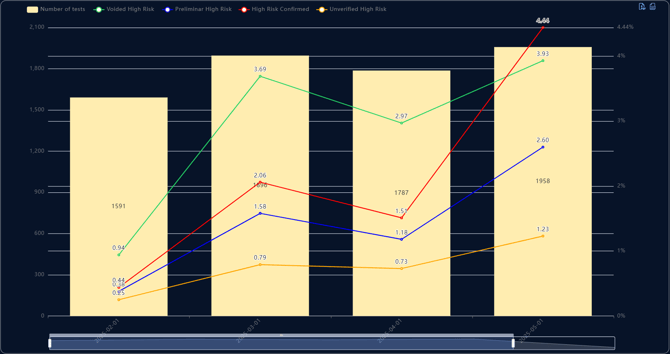
The report Test Count vs Confirmed High-Risk Case Rate combines two key indicators in a single chart: the total number of tests performed over a given period and the rate of confirmed high-risk cases detected in that same interval.
How does this report work?
-
Displays bars with the total number of tests performed over a period (day, month, or quarter).
-
Overlays lines with the confirmed high-risk case rate (%).
-
Enables observation of the relationship between the number of tests conducted and the relative frequency of risk events.
Available filters
-
Date: define the analysis time range.
-
Group: segment information by teams, shifts, or work areas.
-
Grouping: view results monthly or quarterly to enable a more strategic focus.
Usefulness for HSE
-
Helps identify trends over time, showing whether the risk rate increases or decreases relative to the number of tests.
-
Facilitates evaluation of the impact of preventive measures applied in certain periods.
-
Provides a strategic view, as monthly or quarterly grouping reveals more stable patterns less dependent on daily fluctuations.
Conclusion
The Test Count vs Confirmed High-Risk Case Rate report is a key tool for HSE teams seeking to analyze trends. By integrating volume and rate, it helps identify correlations and plan preventive measures with a more strategic approach.