
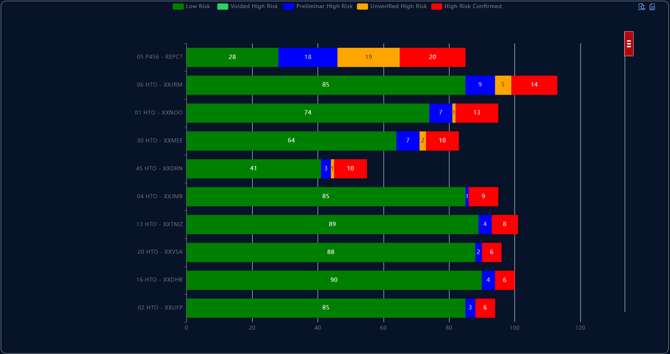
The Count of High-Risk Results vs Low-Risk Results report shows how many results each user obtained in both categories, distinguishing between confirmed high risk, pending high risk, prediction high risk, and low risk. This analysis helps understand the balance of risks against normal tests.
How does this report work?
-
Presents the number of low-risk and high-risk results associated with each user.
-
Distinguishes between different high-risk states: confirmed, pending, or prediction.
-
Lets you see whether a worker accumulates more risk events compared to normal tests.
Available filters
-
Date: select a specific time range.
-
Group: segment by teams, shifts, or areas.
-
User: view an individual worker’s details.
Usefulness for HSE
-
Helps identify users with higher recurrence of high-risk events.
-
Eases comparison between normal tests vs risks across the total population or specific groups.
-
Enables focusing preventive management on workers concentrating more confirmed-risk cases.
Conclusion
The Count of High-Risk Results vs Low-Risk Results report is a key tool to analyze the proportion of risk events in operations. Its ability to differentiate high-risk types and compare them with normal tests enables supervisors to act with greater precision in HSE management.